Written by Will Linville, UDC Senior Urban Designer + Planner, AICP, CNUa
I’ve worn many hats in my fourteen years in the planning profession, and that makes me an effective planner and designer. A few hats ago, I actually had Friday afternoons reserved for issuing yard sale permits (no more than four per home per year, thank you). Planners must be generalists, and working in multiple roles within the planning world (transportation, entitlements, long range, urban design, etc.) allows you to quickly adapt to different project types. I often find that wearing my long-range planner hat helps me notice things that I otherwise might not see.
Traditionally, in long-range planning frameworks, there were a handful of existing land uses that would directly translate to their future land use. I used this as a standard approach when creating existing and future land use maps for comprehensive plans. The GIS script I’d use to ensure land use preservation is baked into my brain and looks a little something like this:
If [“existing_land_use”] IN [“institutional”, “church”] :
[“land_supply”] = “utilized”
This programming language communicates that institutional uses (government buildings, churches, etc.–sometimes even golf courses) would always be marked as utilized, and therefore the existing land use of those parcels would remain that way into the future. At least through the horizon year of the long-range plan (say 20 years), the institution would not see redevelopment.
The reality now is that’s becoming less of a sure thing. I started noticing in my last few years as a long-range planner is that some uses (like schools or golf courses) were increasingly on the table for some kind of redevelopment . In both of those examples, the acres upon acres of formerly manicured grass were now overgrown and desperate for new life.
Places of worship, especially in dense centers, are increasingly seeing a similar fate.
Places of Worship and the Neighborhood
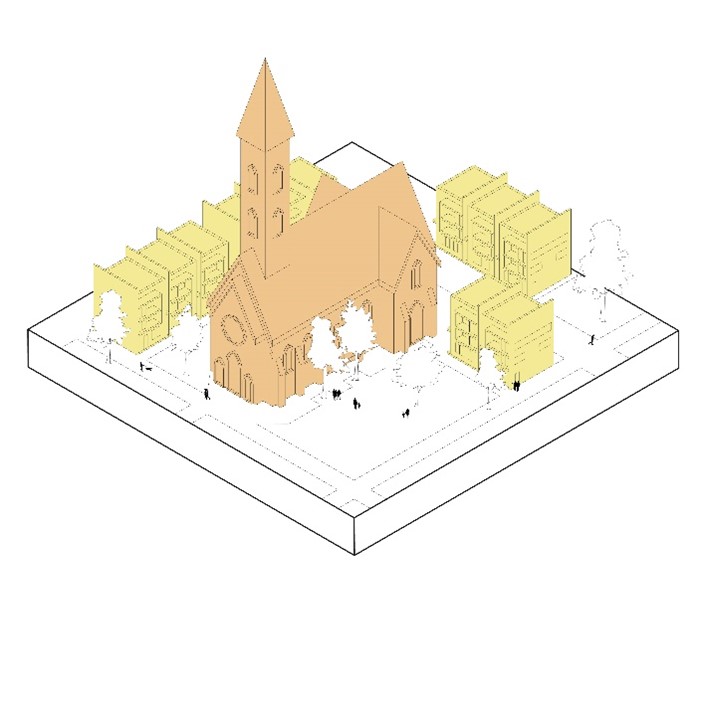
Places of worship typically consist of a large sanctuary (sometimes two if the church has been around for a while), some outbuildings, and a whole lot of underutilized land with mature trees and lawn that often becomes an unofficial community park space where folks can walk, sit, and get to know their neighbors.
They almost always serve a bigger purpose to a neighborhood than worship only–including soup kitchens, shelters, and a place for after hours community engagement (heck, planners use those spaces for public meetings all the time). They also serve a purpose in creating quality urban environments. For centuries in the United States and Europe, churches have been used to anchor plazas, bookend neighborhood blocks, and define a city’s skyline through its vertical waypoint, the spire.
A Failing Church’s Fate
American rates of attendance at places of worship have been declining for decades, a trend accelerated by the COVID-19 pandemic. Declining religious attendance has led to smaller congregations. As a result, churches are no longer out of bounds when it comes to redevelopment. Over the past half decade, I’ve noticed a handful of ways that declining sanctuaries in Charlotte have met their end, and I’ve developed special designations for each:
- The Syncretizer
- The Crusader
- The Divine Intervention
The Syncretizer
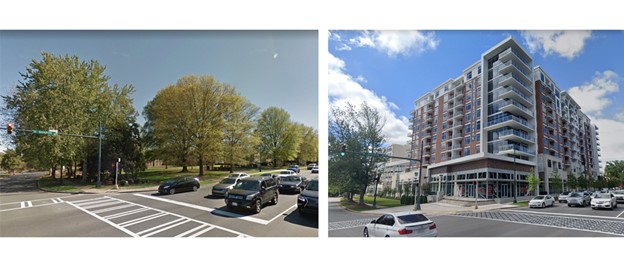
Where SouthPark Church (left) once stood, now Element SouthPark (right) holds a busy corner in Charlotte’s booming SouthPark neighborhood. The church’s new home exists inside the building that replaced it. Long gone are the mature trees and lawn that occupied the space, replaced with a structure more in keeping with the character of the development in and around the mall area.
The Crusader
This is never a preferred outcome, but one that happens most frequently. In this example, the former place of worship is considered for adaptation or integration into a larger project, but never materializes. The site may still be rezoned or could be developed by-right, but the commanding presence that the structure held at the corner of a neighborhood street is typically never duplicated by new development. Not only do you lose the presence of the structure, but you often lose the lawns and trees that accompanied it.
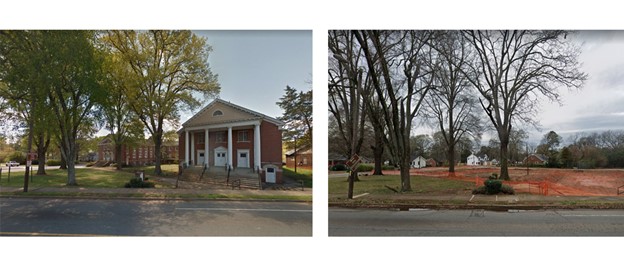
Temple Church, formerly located at the corner of Enderly and Tuckaseegee Roads in West Charlotte, was recently bulldozed to the ground. There is no clear indication of what may take its place. While the trees at the corner were saved, the unique sanctuary buildings was lost forever.
The Divine Intervention
The Divine Intervention is as heavenly as it sounds. This happens when the sanctuary is saved and reused as part of a larger redevelopment effort. This has happened a handful of times in Charlotte – one resulting in flats and townhomes while the other provided a unique co-working space. Not only is the structure saved, but the informal green spaces that surround it are typically preserved in some way as well.
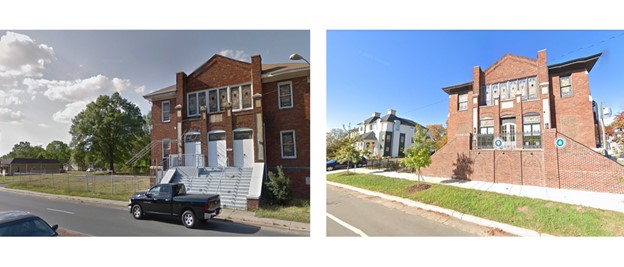
Helton Community Church was integrated into new development and adaptively reused as residential apartments, ensuring the structure will remain a community landmark for decades to come. The structure was very close to the sidewalk, requiring the front steps to be reconfigured to provide streetscape improvements.
What’s the best outcome?
What sounds like a subjective question has an objective answer. We could make the case for smart growth principles, lament the climate change costs of tearing down perfectly good structures for new ones, the loss of tree canopy and quasi-public space, and the further disappearance of community charities. No single alternative addresses each of those, but one can address most: the Divine Intervention. Adaptively reused places of worship can still provide a sense of community and charity, even if the space is no longer used for worship, and deliver it through interaction with others in a mixed community. A contemporary version of an old place where, as author Philip Sheldrake notes in the book The Spiritual City, compassion still bonds strangers.
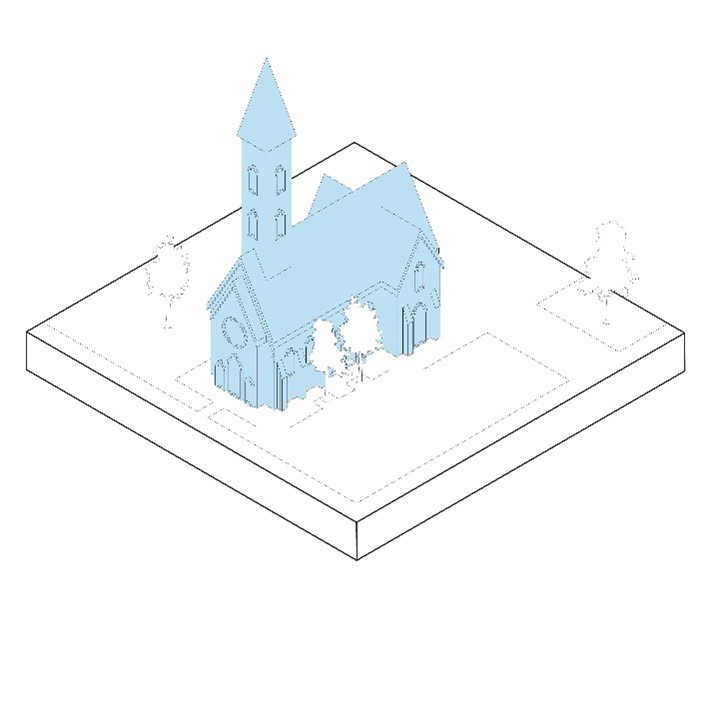
 People make Cities
One response to “Churches and Adaptive Reuse”
Churches and other organizations can create a synergy where both can coexist. Do greater Charlotte has built an innovation lab for youth on the first floor of Shiloh Institutional Baptist Church in the Camp Greene neighborhood. Both orgs exist to serve their unique purposes and still maintain the integrity of the space.
LikeLike